Modern computers can process huge amounts of information within seconds. They support artificial intelligence, scientific research, business operations, and everyday digital services. However, traditional computer architectures still face challenges involving energy consumption, processing speed, and complex data handling.
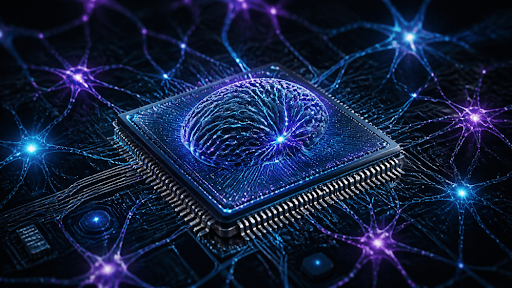
Neuromorphic computing introduces a different approach to computer design. It takes inspiration from how the human brain processes information.
Instead of relying entirely on conventional computing structures, this technology uses specialized hardware that imitates certain functions of biological neural networks. It connects artificial neurons and synapses to process information through electrical signals.
The goal is not to build an artificial human brain. It is to develop computing systems that handle specific tasks more efficiently.
As AI applications become more demanding, researchers are exploring whether brain-inspired chips can reduce energy requirements and improve processing efficiency. Understanding this technology helps explain where the next generation of computer hardware could be heading.
What Is Neuromorphic Computing?
Neuromorphic computing is a computing approach that designs hardware and software around principles found in biological nervous systems.
The human brain contains billions of neurons connected through trillions of synapses. These connections allow the brain to receive information, recognize patterns, learn, and respond to changing conditions.
Neuromorphic systems attempt to reproduce selected aspects of this behavior using electronic circuits.
Traditional computers generally separate memory and processing units. Data moves between these components during computation. This movement can consume time and energy, particularly when systems handle large workloads.
Neuromorphic chips take a different approach. They combine neuron-like processing elements and communication pathways to support distributed information processing.
These chips can process information using networks of artificial neurons. Many designs use spikes or short electrical events to communicate information between connected components.
This approach is particularly relevant to applications involving pattern recognition, sensory processing, robotics, and certain AI workloads.
How Does Neuromorphic Computing Work?
Neuromorphic computing uses electronic systems designed to imitate selected functions of biological neurons and synapses.
To understand the process, it helps to look at three main components.
1. Artificial Neurons
Artificial neurons are electronic or computational units that receive signals from connected components.
They process incoming information and produce an output when certain conditions are met.
In spiking neural networks, for example, neurons communicate through short electrical-like events called spikes.
This allows information to move through the network when activity occurs rather than requiring every component to process information continuously.
2. Artificial Synapses
In the human brain, synapses connect neurons and help regulate communication between them.
Neuromorphic systems use artificial synapses to represent connections between processing units.
These connections can store information about signal strength and influence how the system responds to incoming data.
Some architectures support changes in connection strength, allowing systems to adapt their responses through learning mechanisms.
3. Event-Based Processing
Traditional computing systems often process information through scheduled operations or continuous data flows.
Neuromorphic systems can use event-driven processing. Components respond when relevant signals arrive.
For example, an event-based vision sensor may detect changes in a scene instead of capturing complete images at fixed intervals.
This can reduce unnecessary processing when little is happening in the environment.
The combination of artificial neurons, synaptic connections, and event-based processing creates a different approach to handling information.
Neuromorphic Computing vs Traditional Computing
Both computing approaches process information, but their hardware structures and operating principles differ.
Traditional computers generally use the Von Neumann architecture. It separates the processor and memory, allowing them to perform different functions. Neuromorphic systems use brain-inspired structures that bring processing and memory-like functions closer together.
Here are the main differences:
| Comparison | Traditional Computing | Neuromorphic Computing |
| Architecture | Conventional processor and memory structure | Brain-inspired architecture |
| Processing | Instruction-based operations | Often event-driven processing |
| Data movement | Frequent movement between memory and processor | Designed to reduce data movement |
| Energy usage | Varies with workload and hardware | Can be efficient for selected workloads |
| Learning | Usually depends on separate algorithms and training systems | Can support adaptive neural mechanisms |
| Applications | General-purpose computing | Specialized AI and sensory tasks |
Traditional processors remain better suited to many everyday computing tasks. They support operating systems, office applications, databases, and a wide range of software.
Neuromorphic hardware focuses on workloads that benefit from parallel processing and event-driven communication.
Neither approach makes the other unnecessary. Both can serve different roles within future computing systems.
Key Benefits of Neuromorphic Computing
Neuromorphic computing has attracted attention because it addresses several limitations associated with conventional computing architectures.
Its benefits depend on the chip design and the task being performed.
1. Improved Energy Efficiency
Energy consumption is a major concern in modern computing.
Large AI systems require powerful processors to handle training and inference workloads. Data centers also need electricity for cooling and supporting their hardware.
Neuromorphic chips can reduce unnecessary processing by activating specific components when signals arrive.
This event-driven approach may lower power consumption for certain applications.
For example, a sensor monitoring a quiet industrial environment does not need to process every possible signal continuously. It can respond when relevant changes occur.
However, energy savings are not guaranteed across every workload. Conventional processors can remain more efficient for tasks they are designed to handle.
2. Faster Response to Specific Events
Some applications need to respond immediately when their surroundings change.
Neuromorphic systems can process signals through parallel networks of artificial neurons. This makes them interesting for real-time applications.
Consider a robot moving through a crowded workspace. It needs to identify obstacles, detect movement, and adjust its position.
An event-driven processing system could help the robot respond to changes without repeatedly processing unnecessary information.
Actual response times depend on the complete hardware and software setup.
3. Better Support for Pattern Recognition
The human brain is highly effective at recognizing patterns in complex information.
Neuromorphic systems borrow selected principles from biological neural networks to handle similar computational challenges.
They may support tasks involving sound recognition, image processing, movement detection, and sensor analysis.
For example, an industrial monitoring system could identify unusual vibration patterns in machinery. It could then alert operators before a minor issue develops into a larger equipment problem.
4. Efficient Processing at the Edge
Edge computing processes information closer to where data is generated.
This reduces the need to send every piece of information to a remote cloud server.
Neuromorphic chips could support edge devices that need low-power processing and quick responses.
Examples include smart cameras, wearable electronics, environmental sensors, and autonomous machines.
These devices often operate with limited power and computing resources. Specialized hardware could help them perform selected tasks without depending on constant cloud communication.
5. Potential for Adaptive Computing
Some neuromorphic architectures support learning mechanisms that modify connections between artificial neurons.
This can help systems adjust their responses as they receive new information.
Such capabilities may be useful in environments where conditions change frequently.
However, neuromorphic learning is not the same as training a large language model. Different architectures use different learning methods, and many still depend on external training processes.
Real-World Applications of Neuromorphic Computing
Neuromorphic computing is moving beyond theoretical research. Scientists, universities, and technology companies are developing hardware and software to explore its practical uses.
Here are some areas where this technology could make a difference.
1. Robotics and Autonomous Machines
Robots need to understand their surroundings before taking action.
They process information from cameras, microphones, motion sensors, and other connected devices. Traditional systems can handle these tasks, but complex environments may require significant computing resources.
Neuromorphic processors could help robots recognize movement, detect obstacles, and respond to changing conditions.
For example, a warehouse robot could identify an approaching worker and adjust its route. It could process relevant visual changes while avoiding unnecessary computation.
This may support more responsive robotic systems, especially where power consumption is a concern.
2. Healthcare and Medical Research
Healthcare systems increasingly use digital technology to support medical research, patient monitoring, and diagnostic workflows.
Neuromorphic computing could help process signals from medical sensors and wearable devices.
For instance, a monitoring device could analyze changing patterns in physiological signals and identify unusual activity for further review.
Researchers are also exploring brain-inspired hardware for applications involving neural signals and brain-computer interfaces.
These developments remain an active research area. Neuromorphic systems are not replacements for clinical diagnosis or established medical equipment.
Healthcare organizations exploring advanced computing can also learn from existing developments in AI in healthcare and its impact on patient care.
3. Smart Cameras and Computer Vision
Traditional cameras capture images at regular intervals. Processing these images can require substantial computing resources.
Event-based vision sensors work differently. They detect changes in brightness at individual pixels and generate events when those changes occur.
Neuromorphic processors can work with this type of data.
This approach may help cameras detect movement, track objects, and monitor changing environments with lower data requirements.
Potential applications include traffic monitoring, industrial inspection, security systems, and autonomous vehicles.
4. Autonomous Vehicles
Self-driving vehicles need to process information from multiple sensors.
They must identify nearby vehicles, pedestrians, road markings, and unexpected obstacles. Their systems also need to respond quickly when road conditions change.
Neuromorphic hardware could support selected perception and sensor-processing tasks.
For example, an event-based camera could detect a fast-moving object without capturing and processing a complete image sequence for every moment.
However, autonomous driving requires much more than fast perception. Vehicles also need reliable decision-making, sensor integration, safety systems, and extensive validation.
Neuromorphic computing is therefore a possible supporting technology rather than a complete solution.
5. Smart Homes and IoT Devices
Smart homes contain connected lights, cameras, thermostats, appliances, and security devices.
These systems collect information throughout the day. Processing every signal continuously can increase energy use and network traffic.
Neuromorphic chips could help selected IoT devices identify meaningful events locally.
For example, a smart security camera could detect movement and activate further analysis only when necessary.
This could reduce unnecessary data transmission and support faster local responses.
6. Artificial Intelligence and Machine Learning
AI applications rely on hardware capable of processing complex mathematical operations.
Most mainstream AI workloads currently run on CPUs, GPUs, and specialized accelerators. Neuromorphic hardware introduces another option for certain neural processing tasks.
Its event-driven architecture may suit spiking neural networks and other applications involving sparse or time-dependent information.
Developers working with intelligent systems can also explore autonomous AI agents and how they work. These systems demonstrate how AI can perform tasks through connected reasoning and actions, although they generally use different computing architectures.
Neuromorphic chips could eventually support selected components of more advanced AI systems.
Examples of Neuromorphic Computing Projects
Several research projects demonstrate how companies and institutions are approaching brain-inspired hardware.
Intel Loihi
Intel has developed Loihi as a research platform for neuromorphic computing.
Its Loihi 2 processor supports large-scale spiking neural networks and provides researchers with a platform to study event-driven computing.
The technology is intended for experimentation with applications such as robotics, adaptive systems, and sensory processing.
IBM NorthPole
IBM introduced NorthPole as an AI inference chip designed around a memory-centric architecture.
It brings computing and memory resources closer together to reduce the costs associated with moving data.
NorthPole is inspired by brain-related principles, although it is not a direct implementation of a biological neural network.
Its design highlights how researchers are exploring alternatives to conventional processor architectures for AI workloads.
Academic Neuromorphic Research
Universities and research institutions are also developing neuromorphic systems.
Their work includes spiking neural networks, event-based vision, adaptive computing, and hardware designed to model neural activity.
These projects help researchers understand where brain-inspired computing can provide measurable advantages.
Challenges and Limitations of Neuromorphic Computing
Neuromorphic computing has considerable research potential, but several challenges still affect its wider adoption.
1. Limited Hardware Availability
Traditional processors are widely available. Developers can access CPUs, GPUs, and AI accelerators through established hardware platforms.
Neuromorphic chips are less common. Access often depends on specialized research platforms and development environments.
This limits the number of developers who can experiment with the technology.
2. Software Development Complexity
Most developers are familiar with traditional programming languages and conventional computing architectures.
Neuromorphic systems introduce different programming methods. Developers may need to understand spiking neural networks, event-driven processing, and specialized hardware tools.
This creates a learning curve for software teams.
More accessible development platforms and documentation could help improve adoption.
3. Limited Industry Standards
The neuromorphic computing industry is still developing.
Different manufacturers use different architectures, programming environments, and communication methods.
This can make it difficult to move applications between hardware platforms.
Common standards and better compatibility will be important for commercial growth.
4. Not Suitable for Every Computing Task
Neuromorphic chips are designed for specific types of workloads.
They may perform well in event-based processing, sensory applications, and selected neural network tasks.
However, they are not necessarily suitable for databases, spreadsheets, conventional business software, or general-purpose computing.
Businesses must evaluate their requirements before investing in specialized hardware.
5. Integration and Implementation Costs
Introducing a new computing architecture requires more than purchasing a processor.
Organizations may need specialized software, trained developers, compatible sensors, and changes to existing infrastructure.
These requirements can increase implementation costs.
Companies exploring emerging technologies should carefully assess their objectives and technical readiness. The same principle applies to common AI implementation mistakes that cost businesses money.
A clear implementation strategy can help organizations avoid unnecessary spending and technical complications.
Neuromorphic Computing vs Quantum Computing
Both technologies explore alternatives to conventional computing, but their underlying principles are different.
Neuromorphic computing takes inspiration from biological neural networks. Quantum computing uses principles of quantum mechanics to perform calculations.
| Comparison | Neuromorphic Computing | Quantum Computing |
| Inspiration | Human brain | Quantum physics |
| Main components | Artificial neurons and synapses | Qubits |
| Processing approach | Often event-driven and parallel | Quantum operations |
| Main research areas | AI, robotics, sensory processing | Chemistry, optimization, scientific simulation |
| Hardware | Neuromorphic processors | Quantum processors |
| Current adoption | Specialized research and applications | Research and selected experimental applications |
Neither technology is a universal replacement for traditional computers.
They address different computational problems. Their future development will depend on whether they can deliver practical advantages over existing systems.
What Is the Future of Neuromorphic Computing?
The future of neuromorphic computing will depend on improvements in chip design, software development, and real-world testing.
One important area is energy-efficient artificial intelligence. AI systems increasingly process information across cameras, sensors, connected devices, and cloud platforms.
Neuromorphic hardware could help handle selected tasks closer to where data is generated.
Another area is robotics. Machines operating in unpredictable environments need to recognize changes and respond without unnecessary delays.
Brain-inspired processing could support these capabilities, particularly in applications involving movement and sensory information.
Researchers are also exploring better learning methods. Some neuromorphic architectures aim to adapt their behavior through local changes in artificial synaptic connections.
This could help create systems that respond to new information without relying entirely on conventional training methods.
However, several factors will determine commercial adoption:
- More affordable neuromorphic processors.
- Better compatibility with existing software.
- Easier development tools for programmers.
- Reliable performance across practical workloads.
- Clear advantages over conventional AI hardware.
The technology still needs to prove its value across commercial applications. Research progress alone does not guarantee widespread adoption.
Frequently Asked Questions About Neuromorphic Computing
1. What is neuromorphic computing in simple terms?
Neuromorphic computing is a technology that uses brain-inspired hardware to process information. It uses artificial neurons and connections to imitate selected functions of the human nervous system.
2. How is neuromorphic computing different from traditional computing?
Traditional computers generally separate memory and processing units. Neuromorphic systems use interconnected processing elements inspired by biological neural networks. Many also use event-driven communication.
3. Is neuromorphic computing used in AI?
Yes. Researchers are exploring neuromorphic hardware for AI applications involving pattern recognition, sensory processing, robotics, and spiking neural networks.
4. What are neuromorphic chips?
Neuromorphic chips are specialized processors designed to imitate certain functions of biological neural systems. They use artificial neurons and synaptic connections to process information.
5. Is neuromorphic computing better than quantum computing?
Neither technology is universally better. Neuromorphic computing focuses on brain-inspired processing, while quantum computing uses quantum mechanical principles for specialized computational problems.
6. Can neuromorphic computers replace traditional computers?
Not completely. Traditional computers remain suitable for general-purpose tasks. Neuromorphic systems are more likely to complement existing processors in specialized applications.
7. Which companies are developing neuromorphic technology?
Intel and IBM have developed notable brain-inspired computing projects. Universities and research institutions worldwide are also working on neuromorphic hardware and software.
Conclusion
Neuromorphic computing introduces a different way to design and operate computer hardware. By taking inspiration from the human brain, it explores more efficient ways to process information.
Its potential applications include robotics, healthcare research, autonomous systems, smart sensors, and artificial intelligence.
However, limited hardware availability, software complexity, and integration costs remain significant challenges.
Traditional computing will continue to handle most everyday workloads. Neuromorphic processors may complement existing systems where event-driven processing and energy efficiency offer practical benefits.
As research progresses, brain-inspired chips could become an important part of future computing infrastructure.